Signage CPQ: every job custom, quoted from rules.
What is signage CPQ and which tool fits a sign shop? Signage CPQ is quoting software for sign shops, where every job is custom: letters priced per inch, panels by substrate and area, install by crew-hour. Generic CPQ suits fixed-SKU catalog items, and spreadsheets hold shop rates until a material price or substrate changes. Poly9 AI prices each sign from cost recipes in your shop’s terms and returns price on request when a substrate or finish has no rule.
Signage jobs are configured to order: substrate choice drives area pricing, letter height determines per-inch cost, illumination adds module and power-supply lines, mounting hardware varies by wall type, and install is priced by technician-hours with equipment charges. Jobs naming permits or exceeding height limits route to an estimator.
Generic CPQ tools work for standard catalog items but lack the substrate-by-area and size-band pricing sign shops use. Spreadsheet estimators hold a shop’s rates until a material upcharge changes or a new substrate enters, then the formula breaks or the estimator rebuilds it.
Choose generic CPQ for standard sign products with fixed SKUs. Keep spreadsheets for rough internal estimates. Choose Poly9 AI when every sign job is custom-quoted from shop rates, substrate and finish options change the price, and the quote must reach the buyer before the other shop answers.
The five verbs, plus four that decide it.
Rows the other category wins stay in. Swipe the table on a phone.
| What matters | signage CPQ | Poly9 AI |
|---|---|---|
| Answer | An email form or phone intake. The estimator produces the quote during business hours. | Answers the buyer on your site, at the trade show or on the phone, from your catalog and rates. |
| Configure | Intake forms with dropdowns for standard options. Custom jobs: manual entry by the estimator. | Plain language: "4×8 ACM panel, printed, stand-off mounts." Your rules refuse invalid substrate-mount pairs. |
| Price | Formulas in a spreadsheet, one per substrate and size band. Missing rules break the estimate or force a guess. | Substrate by area, letters per inch, illumination per module, install per hour. Missing substrate returns price on request. |
| Quote | A PDF line-item estimate emailed after the estimator reviews it and adjusts the spreadsheet. | No spreadsheet. The quote goes out with substrate, install and timing. Buyer approves on their phone. |
| Present | Stock photos or a hand-drawn sketch attached to the email. | Renders the letters on the building or the panel with the logo, labeled as a render. |
| Exceptions routing | Manual review: the estimator flags permit requirements and site conditions by hand. | A job naming a permit, exceeding height limits or requesting a site survey routes to a person with the draft quote attached. |
| Learns your business | Static until the estimator updates the spreadsheet. Tribal knowledge stays with the estimator. | Learns from every question, quote and collection which rules are missing and which jobs route to exceptions. |
| Pricing model | Per seat per year for CPQ platforms, or free for spreadsheets owned by the estimator. | One credit per sales action. $100 buys a thousand, everyone on the team included. |
| Time to first quote | Depends on estimator availability. Instant for spreadsheets if the substrate and size match a row. | Same day with a sample catalog. Certified quotes once shop rates are written as recipes. |
Category behavior is described in general terms; specific products vary. Poly9 AI behavior is as shipped in September 2026.
The five steps. Price comes from approved rules, or returns price on request.
Why the differences matter.
Signage CPQ is configure-price-quote for sign shops where products are built to order. A channel letter set sizes per inch of height. A flat sign prices by substrate and area. A monument sign adds foundation and electrical lines. Install is quoted by technician-hours with equipment charges. Jobs naming permits or exceeding height limits route to an estimator with the draft quote attached.
Generic CPQ platforms handle catalog items with fixed SKUs well. Signage is the opposite: every job is configured from the buyer’s spec. A 4×8 ACM panel printed full-bleed with stand-off mounts has three pricing variables before install. A nine-letter channel set at 18 inches with red acrylic faces and a raceway prices letters per inch with a face-material multiplier, the raceway per linear foot, LED modules per letter, and a two-technician install with equipment. Poly9 AI holds each as a cost recipe: substrate by area with a finish upcharge, letters per inch with face and return rules, and install per hour from crew rates.
Substrate choice is the first fork in sign pricing. ACM, MDO, PVC, aluminum, acrylic and dibond each have their own cost per square foot, and finishes like brushed, printed or vinyl-applied add a second multiplier. A spreadsheet estimator holds these as rows or tabs. When the acrylic supplier raises prices or a new substrate like polycarbonate enters, the estimator adds a row or rewrites the formula. Poly9 AI prices each substrate from its recipe, and when a substrate has no rule it returns price on request and drafts the request for the estimator. It never guesses.
Size-driven pricing is how sign shops quote channel letters and dimensional elements. Height in inches determines base cost, then face material, return finish and illumination each add their line. A spreadsheet models this as nested formulas: letter count times height band times face multiplier plus LED modules. The formula works until a buyer asks for a height the sheet does not cover or a return finish the shop just started offering. Poly9 AI applies the per-inch rule, checks the face and return against the materials catalog, and refuses combinations your compatibility rules forbid, such as wood returns on an outdoor illuminated sign.
Illumination adds three lines: LED modules priced per letter or per linear foot, power supply sized to the module count, and electrical rough-in at the install site. A sign shop’s rules usually say one module per channel letter and one power supply per raceway, with a rough-in charge when the site has no existing conduit. Poly9 AI reads those rules, applies them, and adds the lines. A spreadsheet holds them as separate tabs, and the estimator copies the numbers by hand.
Install and mounting are priced by crew-hours and equipment. A wall-mount sign at ten feet takes two technicians and a ladder. A raceway install at higher elevations may need a bucket truck. A monument sign adds foundation work and a crane for the cabinet. Poly9 AI quotes install from your crew rates and equipment charges per the job’s height and mounting rule. When a job exceeds the height your rules cover or the site needs a survey, it routes to the estimator with the partial quote attached instead of guessing an install price.
Permits vary by jurisdiction and sign type. Some cities require permits for any illuminated sign, others only above a size threshold. A sign shop's estimator usually carries these rules in their head. In Poly9 AI, a job that names a permit, a height over your rule's limit or a site survey routes to a person with the draft quote attached, instead of being priced blind.
Proofs and production timing follow the sign's complexity. A printed flat sign often ships after one proof cycle. An illuminated channel set may need a digital proof and a color match before the buyer signs off. Some shops add rush fees for expedited jobs, and the policy varies by shop.
Learning matters in signage because every shop’s rates and material preferences differ. One shop prefers ACM for flat signs, another uses MDO. Poly9 AI learns from every question, quote and collection which rules are missing and which jobs route to a person. The cost recipes stay yours; the memory layer shows what to price next.
Pricing models follow seat count or sales actions. Per-seat CPQ platforms charge the same whether the shop quotes five jobs a week or fifty. Spreadsheets are free but live in the estimator’s files and break when that person is out. Poly9 AI is one credit per sales action, so the cost follows the quotes sent. Everyone on the team quotes from the same rules, and the cost is $100 for 1,000 credits.
Speed matters because sign buyers often contact multiple shops. A spreadsheet is instant if the substrate and size match a row the estimator already built. Poly9 AI is same-day with a sample catalog. Certified quotes follow once shop rates are written as recipes.
- Standard sign products sold from a catalog with fixed SKUs and prices, no custom configuration.
- Shops where one estimator owns the pricing and they prefer their own spreadsheet system.
- Large shops with ERP-driven workflows where every job must enter through validated approval chains.
- Every sign job is custom: substrate by area, letters per inch, illumination and install priced from shop rates.
- Buyers ask on your website, at trade shows or on the phone, and speed wins the job.
- The quote must be certified and traceable, and price on request beats a guessed substrate or install price.
- Multiple people on your team quote, and the rules should apply the same way every time.
- The estimator spends their day writing quotes for standard jobs instead of reviewing exceptions.
- Material prices change and updating one recipe beats rewriting formulas in ten spreadsheet tabs.
Many sign shops keep a spreadsheet for rough internal estimates and one-off material cost checks, and use Poly9 AI for buyer-facing quotes. The sales team quotes from Poly9 AI with certified substrate and install pricing. The estimator models complex jobs with site-specific conditions in a spreadsheet, then migrates the proven rates into cost recipes once the job is settled.
Ask for an option you have not priced.
Whatever you compare it with, run this on your own catalog. Poly9 AI prices from your recipes and matrices through one engine, and when the rule is missing it says “price on request” and drafts the request. The tool that produces a plausible number instead is the one that costs you an order.
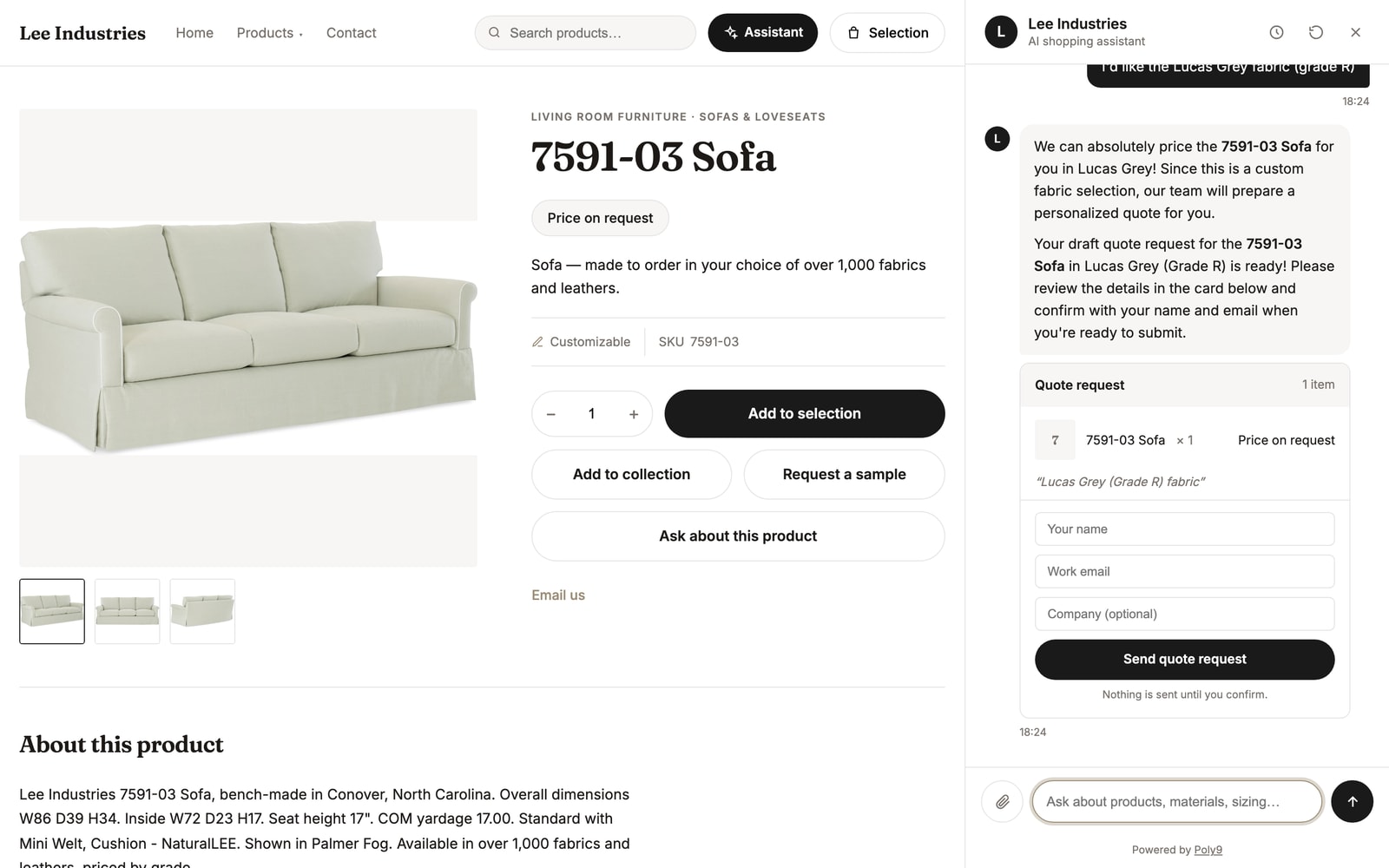
Real storefront: an option with no price rule gets price on request. Substrate rules work the same way.
Questions about signage CPQ.
Does signage CPQ handle channel letters and flat signs together?
Can it price substrate by square footage with finish options?
What happens when a substrate or size is not in the shop’s rules?
Can it quote install by crew-hours and equipment charges?
What about permits and rush fees?
Can multiple people on the team quote from the same shop rates?
Does it work for monument signs and dimensional elements?
- Poly9 AI plan catalog, September 2026
Start free. Judge it on your own catalog.
Create your account, add your catalog or start with your industry’s sample catalog, and ask the question you would ask the other tool. 250 sales actions free, no card, and the account stays yours.