Aftermarket CPQ: quoting accessories, parts and add-ons.
What is aftermarket CPQ and which tool fits? Aftermarket CPQ is configure-price-quote for accessories, add-ons, replacement parts and custom options sold after or alongside the core product. The approaches are generic CPQ tools, spreadsheets and custom-product quoting platforms. Generic CPQ handles standard parts catalogs and ERP order entry. Spreadsheets work until options multiply or COM pricing needs a grade matrix. Poly9 AI prices custom aftermarket products from cost recipes, returns price on request when a rule is missing, and quotes without an Excel rebuild.
Aftermarket products range from standard replacement parts with fixed SKUs to custom accessories configured per order. Examples: furniture cushions in COM, cabinet hardware in custom finishes, window grilles by size.
Generic CPQ tools handle standard parts catalogs and ERP integration. Spreadsheets work for simple lists. Both break when aftermarket options are custom-configured: a cabinet pull in brushed brass with custom backplate dimensions, or a sectional ottoman in the buyer’s grade F fabric.
Choose generic CPQ for standard parts with fixed SKUs and ERP workflows. Keep spreadsheets for one-off estimates. Choose Poly9 AI when aftermarket products are custom-configured with options, materials or variants, and the price must come from your rules.
The five verbs, plus four that decide it.
Rows the other category wins stay in. Swipe the table on a phone.
| What matters | aftermarket CPQ | Poly9 AI |
|---|---|---|
| Answer | A parts list or catalog. The buyer asks a rep during business hours. | Answers the buyer from your catalog on your site, in chat or at the booth, at any hour. |
| Configure | Standard parts: fixed SKUs. Custom accessories: forms, dropdowns or spreadsheet inputs. | Plain language: “brushed brass pull, 4-inch centers.” Your rules refuse incompatible options. |
| Price | Fixed prices for standard SKUs. Formula per row or admin-maintained tables for custom. | Cost recipes for custom accessories. Missing rule returns price on request, never a guess. |
| Quote | A line-item PDF or ERP order, often rebuilt in Excel before it goes to the buyer. | No Excel rebuild. The buyer approves the accessory quote on their phone in one tap. |
| Present | Stock photos or generic part images. | Renders the accessory in chosen materials from your library, labeled as a render. |
| Standard parts and ERPThey win this row | Built for fixed-SKU parts catalogs, inventory lookups and ERP order entry. | Built for custom-configured accessories. Standard SKUs work; custom options are the strength. |
| Learns your business | Static rules until the admin updates them. | Learns from every quote which accessories sell together and which rules are missing. |
| Pricing model | Per seat per year, or free for spreadsheets. | One credit per sales action. $100 buys a thousand, everyone on the team included. |
| Time to first quote | Instant for standard parts. Days to weeks for custom accessory rules and ERP integration. | Same day with a sample catalog. Certified quotes once your first accessory pricing rule is written. |
Category behavior is described in general terms; specific products vary. Poly9 AI behavior is as shipped in September 2026.
The five steps. Price comes from approved rules, or returns price on request.
Why the differences matter.
Aftermarket CPQ is configure-price-quote for anything sold after or alongside the core product. Standard replacement parts with fixed SKUs, accessories configured to match the original order, and add-ons built to the buyer’s spec. A furniture maker quotes an ottoman in the same grade F fabric as the sectional the buyer ordered last year. A cabinet manufacturer prices custom pulls in brushed brass with non-standard centers. A window company quotes replacement grilles by size and finish for a job installed five years ago.
Generic CPQ tools and parts catalogs handle standard SKUs well: part number, price, availability, ERP order entry. Poly9 AI handles both standard and custom. A standard part with a fixed SKU is a product in the catalog with one price. A custom accessory is a configure-to-order product with options, materials and cost recipes, the same structure as the core products.
Configuration is where aftermarket quoting splits. Standard parts have no configuration: the buyer gives the part number, the system looks up the price. Custom accessories configure the same way core products do. Poly9 AI asks in plain language, enforces compatibility constraints from your recipes, and refuses invalid combinations with a reason. A brushed brass pull requires brass-compatible mounting. An upholstered ottoman in COM requires a grade matrix entry for that fabric.
Pricing follows the same line. Fixed SKUs are lookups. Custom accessories price from cost recipes and grade matrices. When a recipe is missing, Poly9 AI returns price on request and drafts the internal request for your estimator. It never guesses. Generic CPQ tools apply admin-maintained price tables; when the table is incomplete the quote fails or the rep fills the gap in Excel. Spreadsheets work until the options multiply or the COM grade matrix needs a lookup across files.
The Excel rebuild is common in aftermarket quoting. A rep pulls the accessory line items from a CPQ or ERP, exports to Excel, adds the custom options the system does not know, adjusts the layout and emails a PDF. Poly9 AI sends the quote from the conversation: the buyer opens it on their phone, sees the accessory rendered in the chosen materials, and approves in one tap. No file, no rebuild, no versioning.
Rendering matters for custom accessories the same way it does for core products. A stock photo of a generic pull does not close the sale. Poly9 AI renders your pull in brushed brass from your materials library, on a cabinet door, labeled as a render. A sectional ottoman appears in the buyer’s grade F fabric next to the sofa they ordered. The render and the certified price land in one quote.
Standard parts catalogs are built for inventory, availability and ERP integration. That is their strength and where Poly9 AI does not try to replace them. For custom-configured aftermarket products, the ERP still holds the order. Poly9 AI quotes the custom accessory, the buyer approves, and your team enters the approved order the way it enters core product orders today.
Memory is the difference between a tool that prices and one that learns. Generic CPQ knows the rules the admin programmed. Poly9 AI learns from every aftermarket quote: this buyer always orders replacement cushions in the same grade as the original, these two accessories sell together, this finish option is missing a price rule. The cost recipes are still yours. The memory shows what to price next.
Pricing models follow usage. Per-seat CPQ licenses cost the same whether the seat quotes twice a week or forty times. Spreadsheets are free or included with office software. Poly9 AI is one credit per sales action, so a showroom or dealer network with occasional aftermarket quotes pays for the quotes they send, not the logins. Four reps sending 30 accessory quotes a week use about 500 credits a month, or $50, at the plan catalog rate of $100 for 1,000 credits.
Speed to first quote depends on the accessory. A standard SKU with a fixed price is instant in a parts catalog. A custom-configured accessory with options and materials is a configure-to-order product. Poly9 AI handles it the same day you write the cost recipe: create the accessory product, write the pricing rule in plain language, and send the first certified aftermarket quote in the same session.
- Standard replacement parts with fixed SKUs, no configuration, looked up from inventory.
- ERP-driven workflows where every order must enter through validated approval chains.
- High-volume parts businesses where availability and lead time lookups matter more than custom configuration.
- Aftermarket products are custom-configured: accessories in COM, add-ons by size and finish, parts with compatibility constraints.
- Buyers ask on your website, in the showroom or at trade fairs, outside business hours.
- The quote must be certified and traceable, and price on request beats a guessed number.
- You rebuild aftermarket quotes in Excel after pulling them from another system.
- The accessory render in the buyer’s chosen materials sells before the spreadsheet does.
Many manufacturers keep a parts catalog or generic CPQ for standard replacement SKUs with ERP integration and use Poly9 AI for custom-configured aftermarket accessories. The parts catalog handles availability lookups and inventory-driven orders. Poly9 AI configures and prices custom add-ons from cost recipes, and order entry stays with the ERP.
Ask for an option you have not priced.
Whatever you compare it with, run this on your own catalog. Poly9 AI prices from your recipes and matrices through one engine, and when the rule is missing it says “price on request” and drafts the request. The tool that produces a plausible number instead is the one that costs you an order.
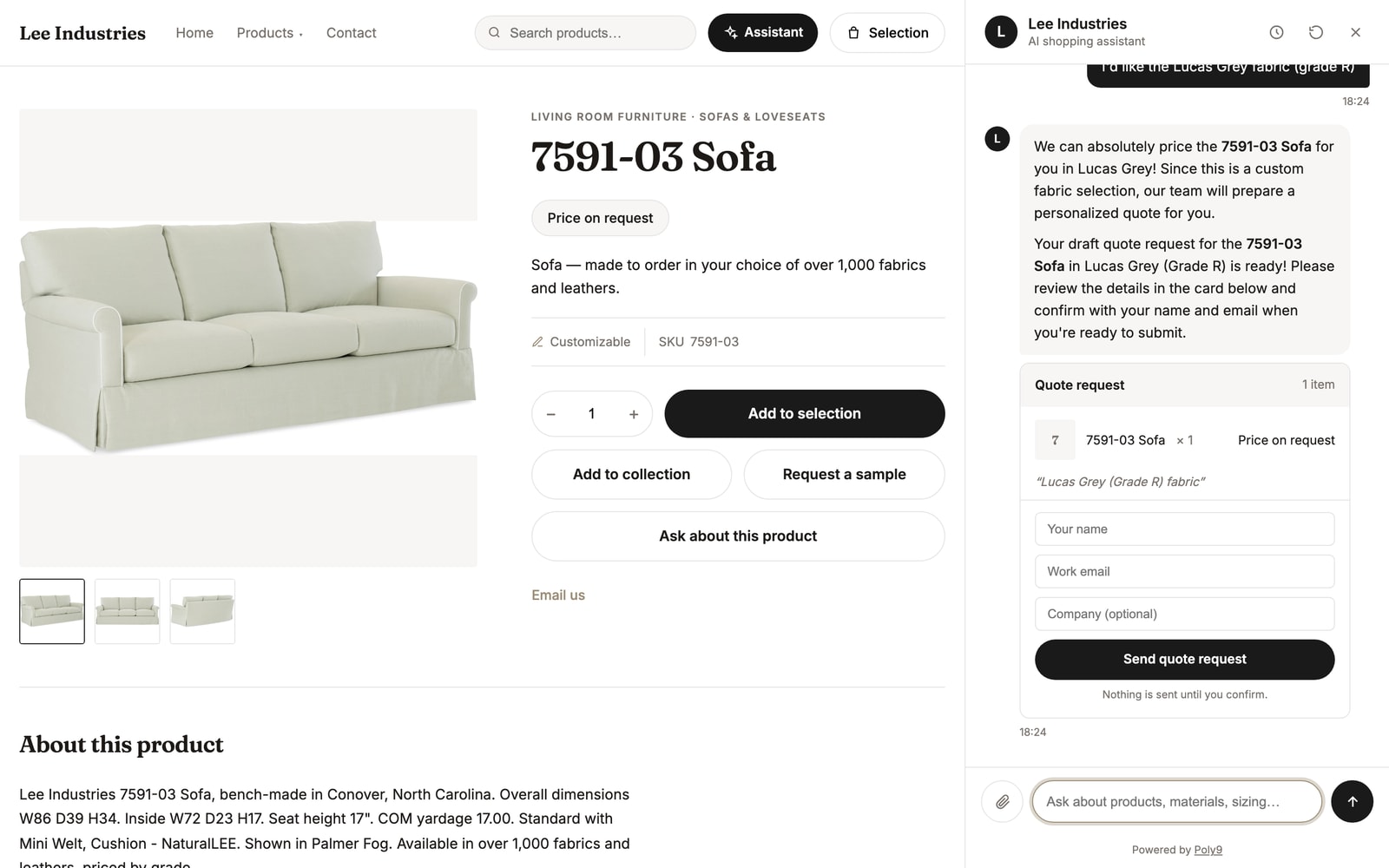
Real storefront: a fabric with no price rule gets price on request, not a guessed number.
Questions about aftermarket CPQ.
What counts as an aftermarket product?
Does Poly9 AI handle standard replacement parts?
Can it enforce compatibility between accessories and core products?
What happens when an accessory pricing rule is missing?
How do aftermarket quotes get into the ERP?
- Poly9 AI plan catalog, September 2026
Start free. Judge it on your own catalog.
Create your account, add your catalog or start with your industry’s sample catalog, and ask the question you would ask the other tool. 250 sales actions free, no card, and the account stays yours.