Jewelry CPQ: metal, stone, setting, quoted.
What is jewelry CPQ and which tool fits? Jewelry CPQ is configure-price-quote software for custom pieces priced by metal, stone, setting and band. Generic CPQ handles catalog SKUs, and jewelry configurators render stones and mounts but leave pricing to a spreadsheet. Poly9 AI prices the metal from your daily fix, the center stone per carat, the setting by metal weight and the pavé by stone count, and returns price on request when a stone grade has no rule.
Custom pieces price by metal, stone, setting and band. Metal from the daily fix by karat and weight, center stone per carat by clarity and cut, setting by metal weight, pavé by stone count. A stone clarity with no rule returns price on request for that line; the rest still prices.
Generic CPQ tools handle catalog ordering and inventory. Jewelry configurators render 3D stones and settings but stop at visualization; pricing happens in spreadsheets rebuilt with each metal fix update. Both work until stone varieties multiply or a new metal alloy enters mid-quote.
Choose generic CPQ for catalog jewelry ordering with SKUs. Keep the configurator for CAD renders. Choose Poly9 AI when custom pieces are quoted by metal, stone, setting and band, and price on request beats a guessed stone price for a clarity not yet in the book.
The five verbs, plus four that decide it.
Rows the other category wins stay in. Swipe the table on a phone.
| What matters | jewelry CPQ | Poly9 AI |
|---|---|---|
| Answer | A request form or phone intake. The bench or salesperson produces the quote during business hours or after the CAD render is done. | Answers the buyer from your catalog and rules, at the counter or on your site, with metal and stone options your rules price. |
| Configure | Jewelry configurator renders the stone and setting in 3D. Pricing is manual or a separate spreadsheet step. | Plain language: “Solitaire in 18k rose, 1.2 ct oval, pavé band.” Your rules refuse incompatible stone and setting combinations. |
| Price | Fixed catalog prices for stock pieces, or formulas in a spreadsheet rebuilt when the metal fix changes. Missing stone grade breaks the estimate or forces a guess. | Metal by karat and weight from the daily fix, center stone per carat by clarity and cut, setting by metal weight, pavé by stone count. Missing stone grade returns price on request. |
| Quote | A line-item estimate or order form, often rebuilt in a spreadsheet before it goes to the buyer. | No spreadsheet rebuild. The buyer sees the quote on their phone, with the metal rate and its date on it, and approves in one tap. |
| Present | CAD wireframe or stock product photos. High-end configurators render 3D stone and setting views. | Renders the piece in the chosen metal and cut, labeled as a render, from the product packshot or specification. |
| CAD and designThey win this row | Built for exact stone placement, prong design and bench-ready CAD files. Pricing is out of scope or manual. | Built for the sales layer. Keep the CAD tool for bench work; Poly9 AI prices the piece from metal and stone rules. |
| Learns your business | Static rules until the manager or salesperson updates the spreadsheet or configurator price table. | Learns from every question, quote and collection which metal and stone combinations sell and which clarity grades are missing rules. |
| Pricing model | Per seat per year for CPQ or jewelry platforms, or free for spreadsheets. | Per sales action. One credit per action, $100 for a thousand, everyone on the team included. |
| Time to first quote | Depends on CAD render time and salesperson availability. Instant for spreadsheets if the metal and stone match a row. | Same day with a sample jewelry catalog. Certified quotes once metal fix rate and stone per-carat rules are written. |
Category behavior is described in general terms; specific products vary. Poly9 AI behavior is as shipped in September 2026.
The five steps. Price comes from approved rules, or returns price on request.
Why the differences matter.
Jewelry CPQ is configure-price-quote for custom pieces quoted by metal, stone, setting and band. A jeweler quotes a solitaire ring in 18k rose gold with a 1.2-carat oval diamond and a pavé band. The metal prices by karat and weight in grams from the daily metal fix. The center stone prices per carat by clarity and cut. The setting prices by metal weight. The pavé band prices by stone count. Each is a rule applied in plain language: “Solitaire in 18k rose, 1.2 ct oval, pavé band.” Poly9 AI reads those rules, configures the piece, and builds the quote the same visit.
Generic CPQ platforms handle catalog items with fixed SKUs well. Custom jewelry is the opposite: every piece configures from the buyer’s request for metal, stone, setting and band. A solitaire has pricing variables for metal type and weight, center stone carat and clarity, setting design and weight, and band stone count. Poly9 AI holds each as a cost recipe: metal per gram by karat from the daily fix, center stone per carat by clarity grade, setting by metal weight, and pavé by stone count.
Metal pricing is how jewelers apply the daily fix. 18k rose gold prices per gram at the rate set that morning. 14k yellow gold prices per gram at a different rate. Platinum 950 prices at its rate. A setting in 18k rose at 4.2 grams prices at the 18k rose rate times 4.2. The spreadsheet models this as a lookup and a multiply. The formula works until a new alloy enters or the daily fix was not updated that morning. Poly9 AI applies the metal rule, reads the rate you set for that karat, and shows the rate date on the quote.
Stone pricing is where jewelry quoting gets complex. The center stone prices per carat by clarity and cut. A 1.2-carat oval diamond at G VS2 clarity prices at one per-carat rate. A 1.5-carat oval at the same clarity prices at a higher per-carat rate because larger stones price higher per carat. Lab-grown stones price at a different per-carat rate. Sapphire prices at its per-carat rate. Poly9 AI reads those per-carat rules, applies them to the requested stone, and builds the quote. When a clarity grade has no rule, that line returns price on request and the rest of the quote still prices.
Price on request is the line between an honest quote and a guessed one. A buyer asks for a stone clarity not yet in the book. Generic CPQ tools break the quote when a table entry is missing. Spreadsheets leave the salesperson to fill the gap by hand, and the fill is often a guess that costs the order when the supplier confirms the real stone price. Poly9 AI returns price on request for that line, drafts the internal request for the team with the conversation attached, and never guesses. The buyer gets a partial quote the same visit, and sees the updated total on the same link once the stone price is confirmed.
Setting and band options are how jewelry pricing stays modular. The setting prices by metal weight: a 4.2-gram setting in 18k rose prices at 4.2 times the daily 18k rose rate. A pavé band prices by stone count: 22 stones at the pavé stone rate. Engraving adds a per-piece or per-character charge depending on the jeweler’s rules. Poly9 AI reads those rules, applies them to the configuration, and builds the quote line by line.
CAD configurators are built for bench-ready design: exact prong placement, stone seat dimensions, wax mold output. That is their strength, and Poly9 AI does not try to replace them. The CAD tool draws the piece for the bench. Poly9 AI is the sales layer: it takes the metal, stone, setting and band from the request or from the designer’s specification, prices them from the shop’s rules, and sends the quote the buyer approves at the counter. A jeweler can run both: the CAD tool for bench work, Poly9 AI for the conversation and the certified quote.
Learning matters in jewelry because every shop’s metal preferences, stone suppliers and setting styles differ. One jeweler offers six metal alloys, another offers ten. Poly9 AI learns from every question, quote and collection which metal and stone combinations sell, which buyers always choose pavé, and which clarity grades are missing rules. The cost recipes stay yours; the memory layer shows what to price next.
Pricing models follow seat count or sales actions. Per-seat CPQ or jewelry platform licenses cost the same whether the seat quotes twice a week or forty times. Spreadsheets are free but live in the salesperson’s files and break when the metal fix changes or that person is out. Poly9 AI is per sales action: one credit per action, $100 for 1,000 credits, everyone on the team included.
Catalog load time matters for jewelers rolling out to showrooms or online buyers. You can start the same day from the sample jewelry catalog, add one metal fix rate and one stone per-carat rule, and send the first certified quote in that session. Big jewelry lines get a white-glove import from us. A new stone clarity or metal alloy is one recipe addition, and the team quotes from it on their next ask.
- Catalog jewelry ordering with fixed SKUs and prices, no custom configuration.
- Shops where the CAD tool must own the entire workflow from design to bench and nobody quotes until the render is done.
- Large jewelry manufacturers with ERP-driven workflows where every order must enter through validated approval chains.
- Custom pieces are quoted by metal, stone, setting and band. Karat and weight from the daily fix, center stone per carat by clarity, setting and pavé by metal weight and stone count.
- Your counter staff and showrooms quote from the same book. The metal rate you set that morning applies to every quote that day.
- A missing stone clarity should return price on request for that line, not break the whole quote or force a guess.
- The CAD tool designs the piece for the bench and Poly9 AI prices it from rules. The buyer gets a certified quote the same visit.
- Metal fix updates happen daily and one rate change beats rewriting ten showroom spreadsheets.
A jeweler can keep the CAD tool for bench-ready design and use Poly9 AI as the sales layer. The CAD tool draws the piece with exact prong placement and stone seat dimensions for the bench. Poly9 AI takes the metal, stone, setting and band from the design, prices them from the shop’s rules with the daily metal rate, and sends the quote the buyer can approve. The approved quote goes to the CAD system for final bench files.
Ask for an option you have not priced.
Whatever you compare it with, run this on your own catalog. Poly9 AI prices from your recipes and matrices through one engine, and when the rule is missing it says “price on request” and drafts the request. The tool that produces a plausible number instead is the one that costs you an order.
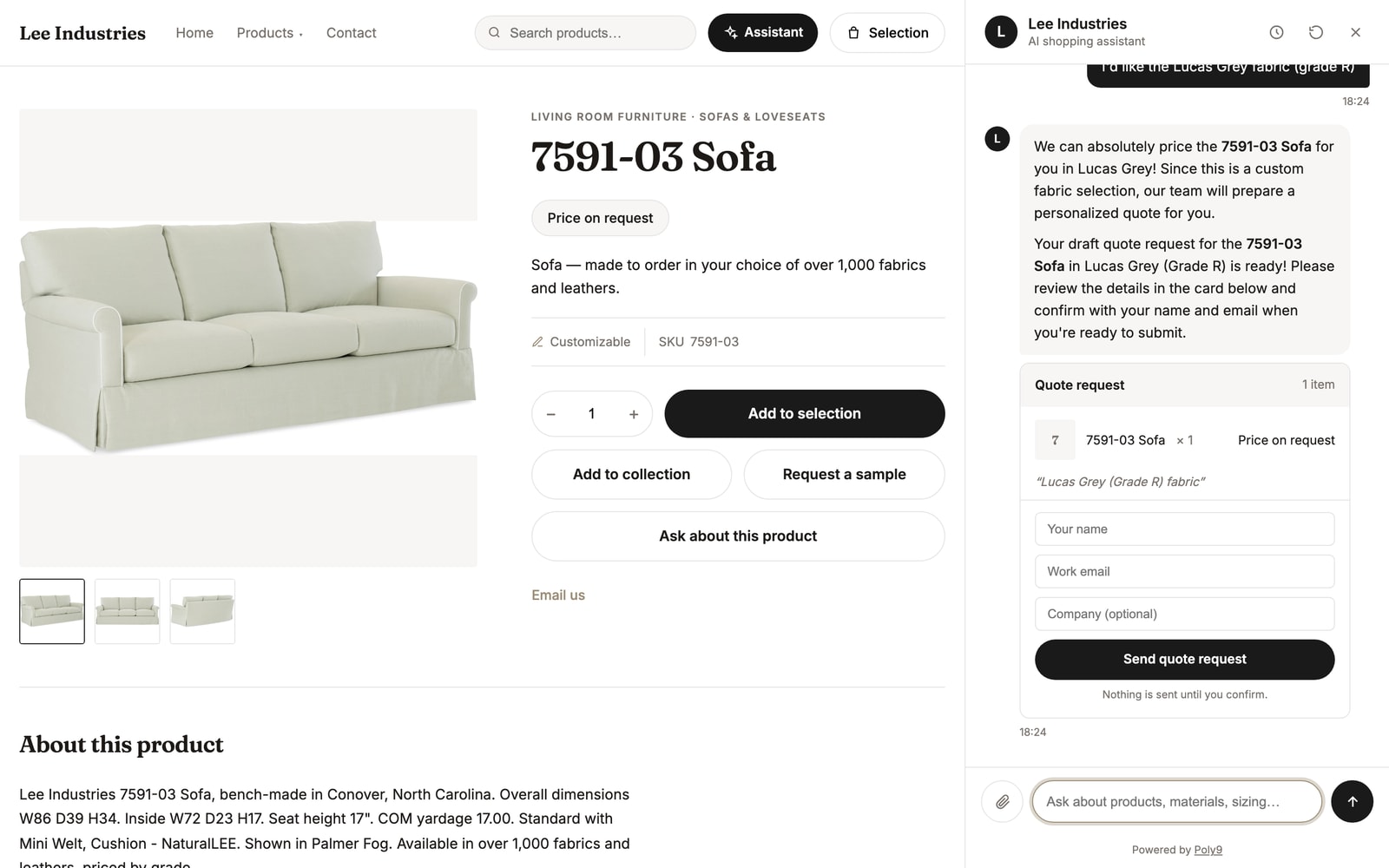
A stone with no rule gets price on request. Demo storefront.
Questions about jewelry CPQ.
Does jewelry CPQ work with metal pricing from the daily fix?
What happens when a stone clarity is not in the book yet?
Can showroom designers see the shop’s net pricing or do they see list?
How does this compare with jewelry CAD configurators?
How long does it take to load a jewelry catalog?
Can buyers configure and quote custom pieces on the jeweler’s site?
- Poly9 AI plan catalog, September 2026
Get started. Judge it on your own catalog.
Create your account, add your catalog or start with your industry’s sample catalog, and ask the question you would ask the other tool. Plans are paid monthly and cancel any time.