The complete guide to selling home goods across borders in 2026
From digitizing your first product to closing a container order — the end-to-end system for manufacturers going direct to global buyers.
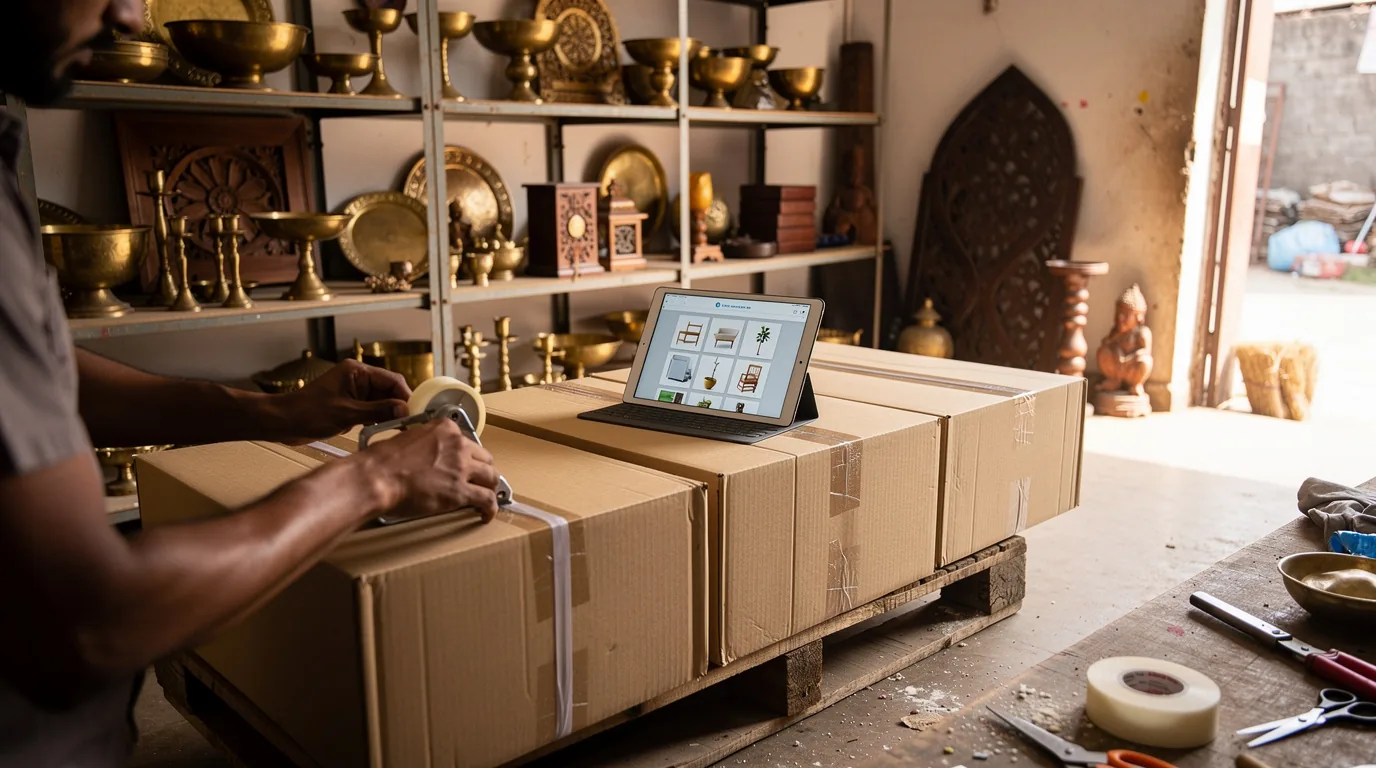
Twenty years ago, selling furniture or decor across borders meant a booth at a trade fair, a printed catalog, and a fax machine. The fair is still worth it. Everything else has changed — mostly in the buyer’s head. Today’s buyer shortlists suppliers online before anyone shakes hands, judges your operation by your digital presence, and gives the order to whoever moves fastest between “interesting” and “here’s your quote.”
This guide lays out the full system — five jobs, in order. Do them well and a 40-person factory can out-sell a competitor ten times its size.
1 · Design: sell the concept before you sample it
The traditional cycle — sketch, tool, sample, ship the sample, wait — burns months before you learn whether a buyer cares. Modern exporters flip it: render the concept photorealistically, put it in front of buyers, and only sample what gets a reaction. AI rendering has made this nearly free. The discipline that matters is catalog-grade consistency: same lighting, same angles, same background system across every concept, so your line looks like a line and not a mood board.
2 · Catalog: structure beats beauty
Buyers don’t reject suppliers because a PDF was ugly. They reject them because the third question — “what’s the MOQ on the walnut version?” — took two days and four messages to answer. A working catalog is structured data: every SKU carries materials, dimensions, finish options, MOQ, lead time, and tiered pricing. One source of truth, one shareable link, always current. If your line lives in Excel today, that’s fine — import it once and retire the attachment habit forever.
A buyer’s trust in your factory is a direct function of how fast accurate answers come back.
3 · Present: curate, don’t dump
Sharing your entire 248-SKU line with every buyer is the digital version of shouting. The exporters who convert curate: a 20-product collection assembled for one buyer’s program, shared as one trackable link. The buyer favorites what fits, annotates what needs changing, and requests quotes in-line. Meanwhile you see opens, dwell time and per-product interest — signal you’ve never had from a PDF.
- Before a fair: send the curated collection two weeks out; book meetings against real interest.
- At the booth: QR capture instead of the card fishbowl — the lead gets your collection instantly.
- After: follow up within 48 hours, while you’re still the supplier they remember.
4 · Quote: the 48-hour rule
Across categories, the first credible quote frames the negotiation — later quotes get compared against it. Hitting 48 hours consistently isn’t heroics; it’s having cost data structured, margin rules pre-agreed, and a quote builder that assembles landed cost in minutes instead of a spreadsheet afternoon. Export as PDF or Excel, whichever the buyer’s process wants, and track every open.
5 · Deliver: the order is the beginning
Repeat orders are where export economics work. They come from one thing: the buyer never wondering what’s happening. Run every order as a shared timeline — sampling, production, QC, shipment — visible to both sides. Flag risks before they slip. A buyer who watched their first order glide from PO to port doesn’t re-shortlist next season; they reorder.
The stack question
You can assemble this from five disconnected tools — a photo studio, a PIM, a link-sharing app, a CRM, a project tracker — and spend your margin on integration glue. Or you can run it as one system where the catalog feeds the collection, the collection feeds the quote, and the quote becomes the order. That’s the bet Poly9 makes, with an AI agent — Poly — working across all five jobs.
Put the system to work. Everything in this guide maps to the platform — digitize your line this week and share your first collection. See the platform →

Free Guide
The Complete Guide to Digitizing Your Export Catalog
Step-by-step playbook to turn physical samples into a digital catalog buyers actually use.
Get the sourcing playbook in your inbox.
One practical tactic every other week. No fluff.